H5P
I spent the month heavily editing and rewriting the PCBs in the Last Frontier case study I use in my classes. I have used this case study during the second week of lab for about a decade to introduce and apply the scientific method in my classes. Instead of using the case study to complete this work, I relied on the paper that the case study is based on and adapted it to use in H5P. I titled the rewritten case study PCBs in the Alaskan Frontier. While the case study is written in the third person, I wanted to revise it in the second person to place the student as the researcher and provide additional guidance and information to support student learning for my asynchronous students enrolled in the online Introduction to Chemistry course. I reviewed how I present the case study in my face-to-face classes and considered how I could guide students through it asynchronously using H5P. I chose to use the presentation options in H5P to create a slideshow that guides students through the case study in sections, providing them with new information as if they were the researcher learning through experimentation. The slideshow includes concept-check questions with instant feedback and embeds videos and images where appropriate. Some images of the case study activity I created are provided to the right.
I will update the case study I use in my face-to-face classes to match the revisions I made for this new version.
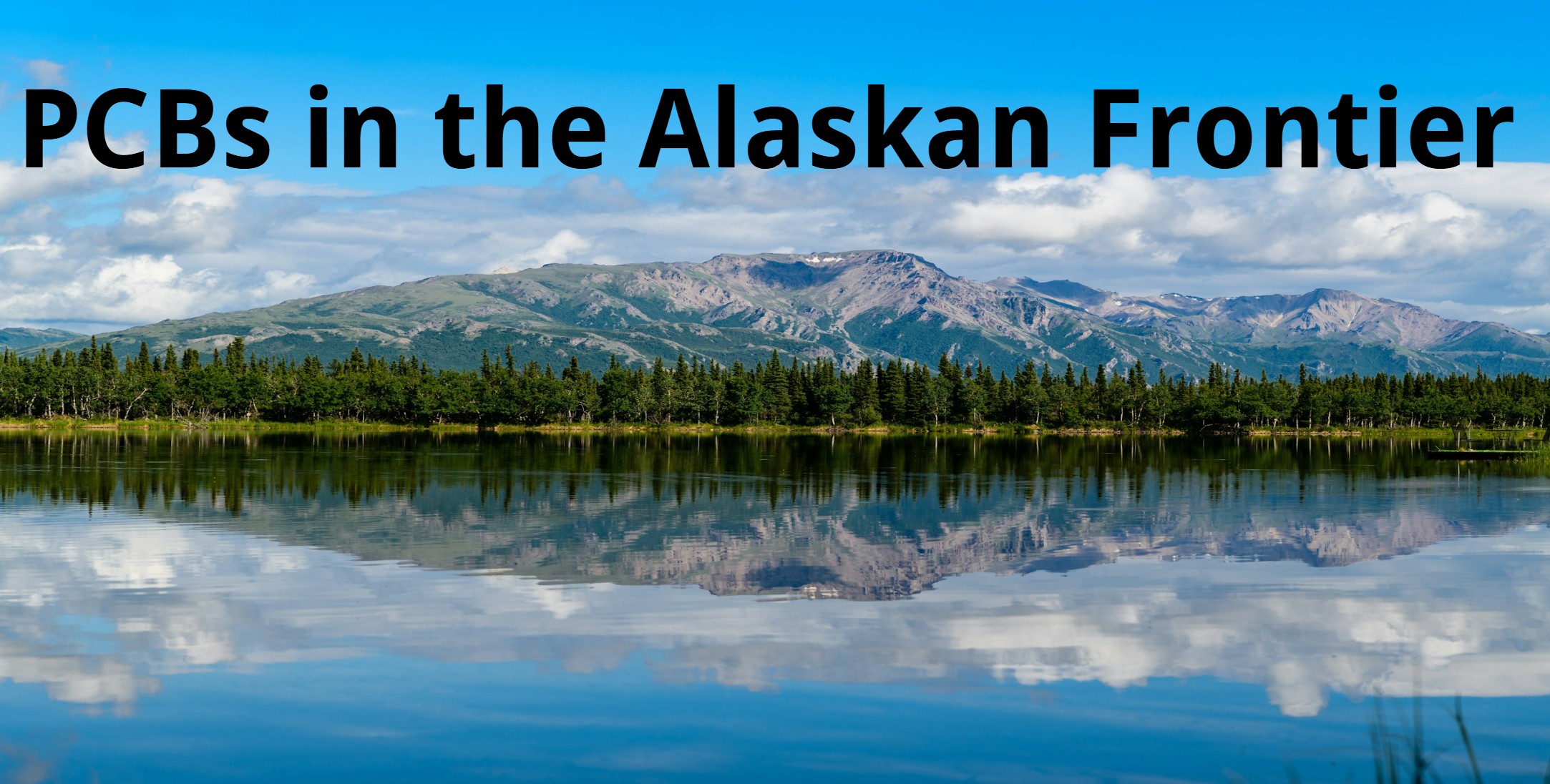
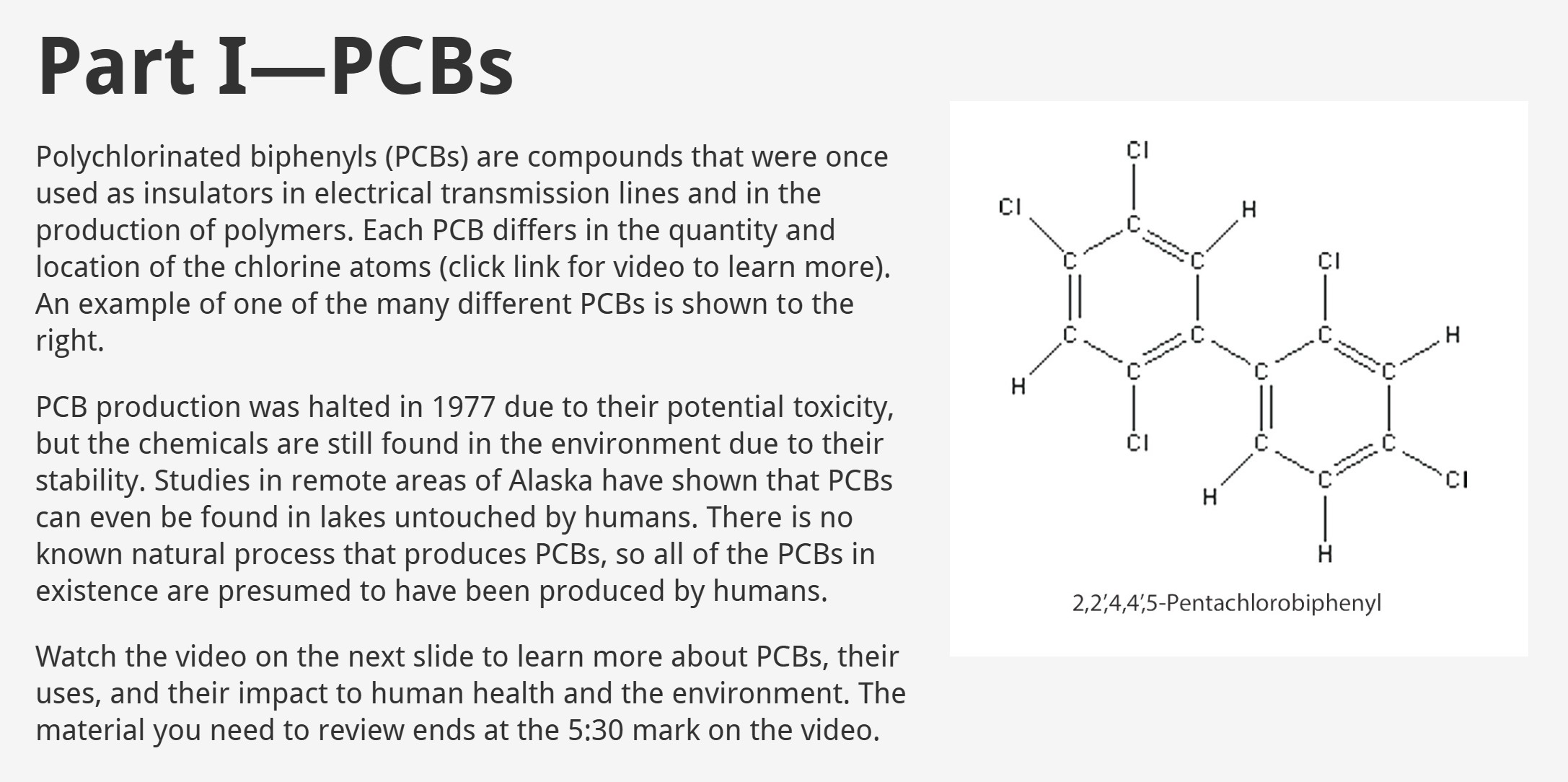
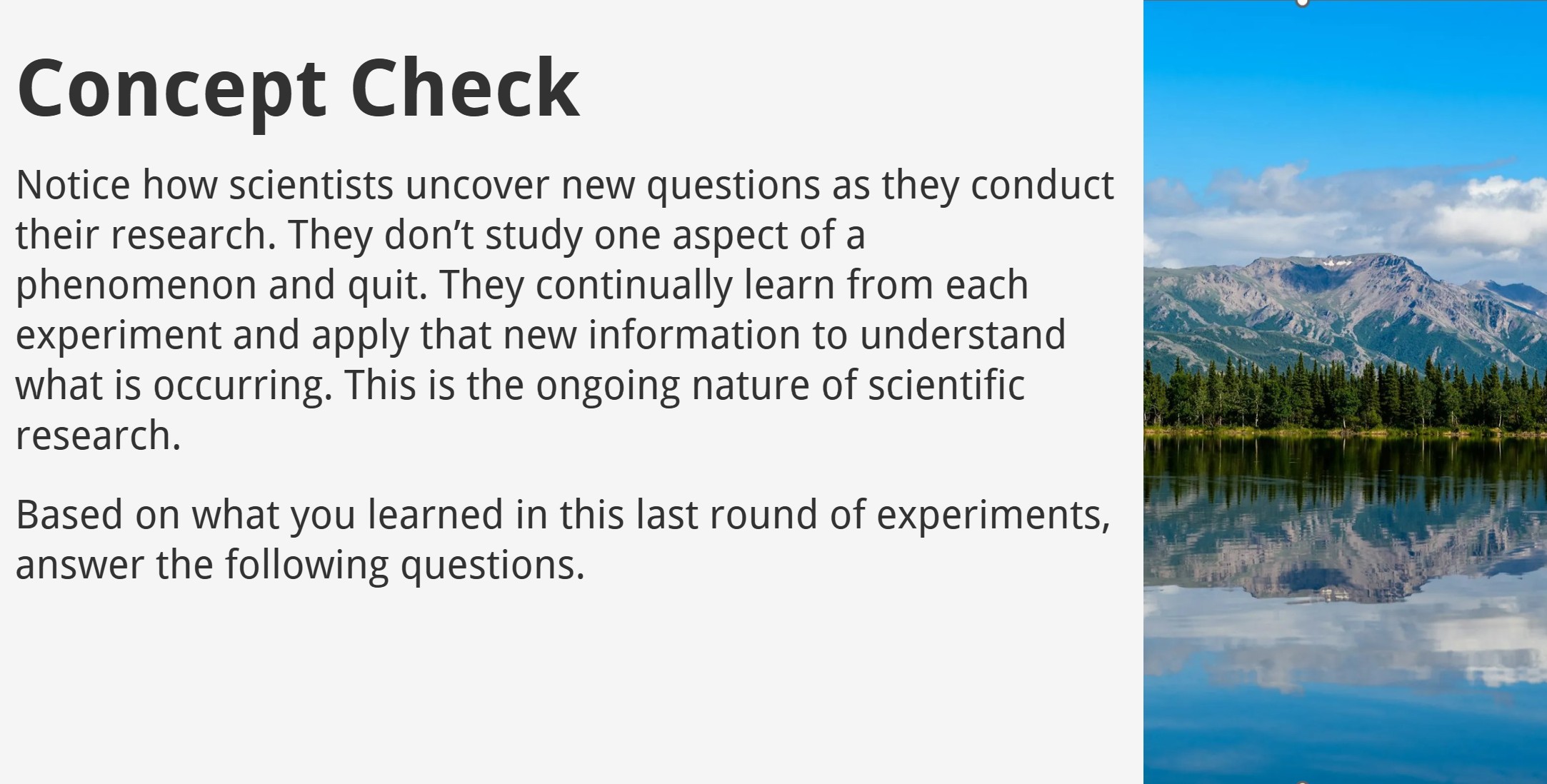
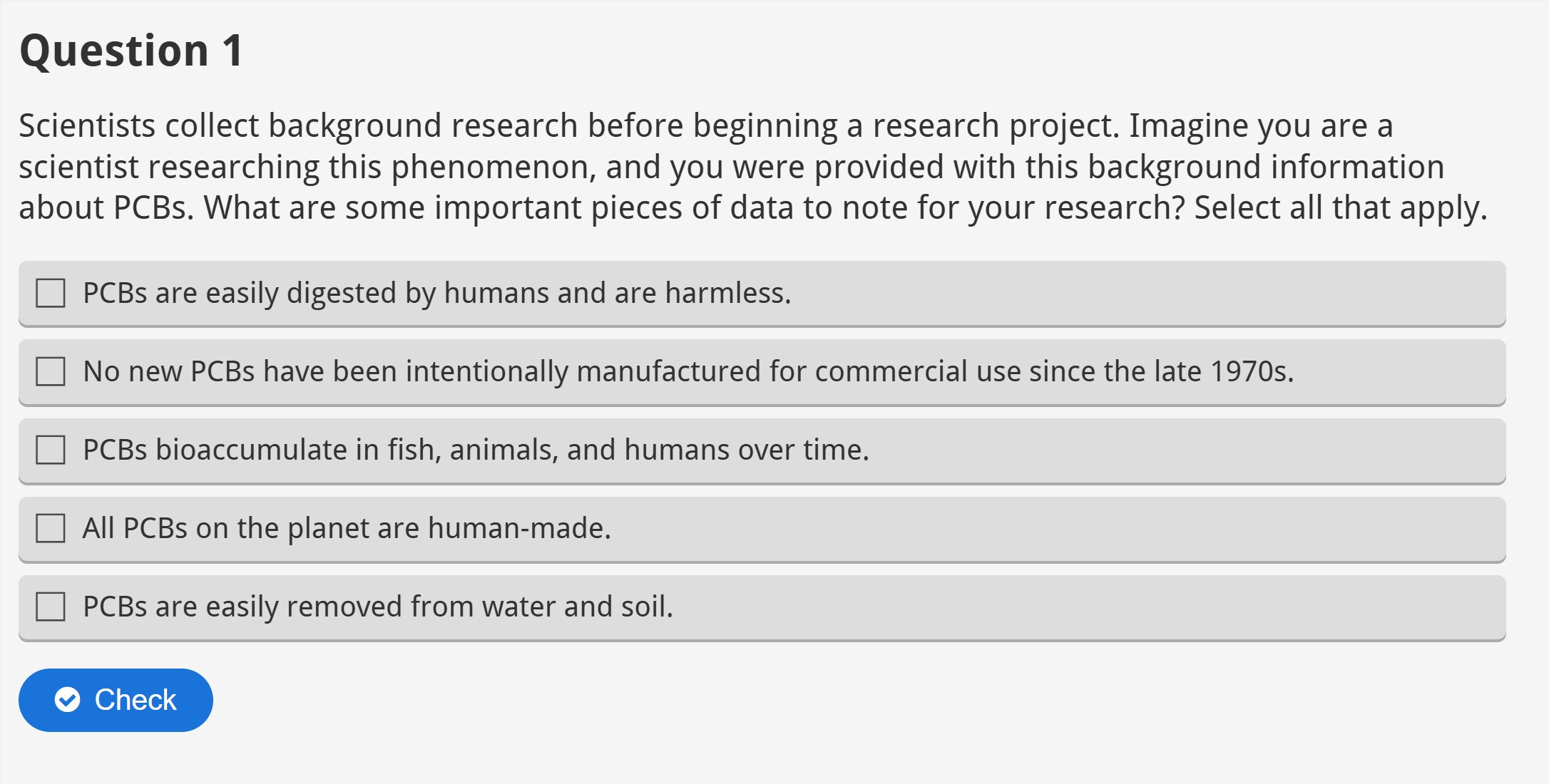
Screenshots from the PCBs in the Alaskan Frontier case study I created in H5P. Hover your mouse over the photos and click the arrows that appear to scroll through the photos.
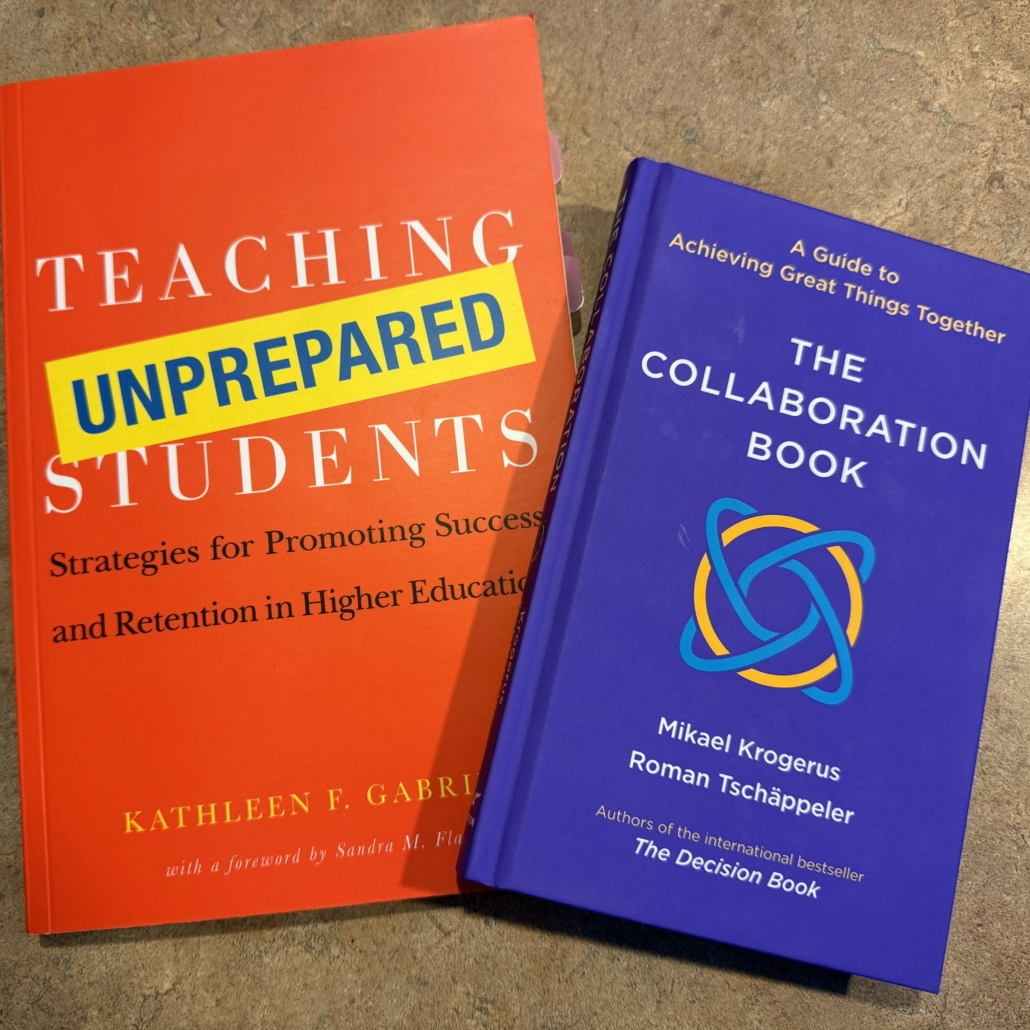
A major misconception that some students have is in their definition of teaching-they believe somehow that teaching is something that can be done only by a professor…Students have to be involved and participate in the process. Teaching Unprepared Students, pg 78
Books
The Collaboration Book by Mikael Krogerus and Roman Tschappeler
The December Leadership Read was The Collaboration Book. This is a good reference book. Each topic is discussed in accessible language and at a short length (2-4 pages). The book is packed with effective and sometimes amusing comics to further illustrate concepts. It is a useful text, but it didn’t resonate with me. Usually, I find ideas and threads I can use in my teaching, but that wasn’t the case with this book. The topics were disjointed, even though they all dealt with collaboration. While I will keep this book for future reference, this isn’t a book that works well if you plan to read it cover-to-cover.
Teaching Unprepared Students by Kathleen F. Gabriel
I included this book in my sabbatical plan because I see unprepared students in my classes every semester, and I was looking for more and better ways to support them. This book is great for a post-secondary educator early in their career, but it’s not the deep dive I was hoping for. While the book provides best practices on designing a syllabus, using rubrics, offering student feedback, and building relationships, I didn’t learn much from it. I am already doing most of what the book recommends in my classes.
Despite this, I did find a new way to help me learn student names, something I struggle with. The book recommended using low-tech name tents to learn student names. Typically, I take lab time to learn student names using a seating chart I create, but students don’t have assigned seating in lecture. Using name tents will help me utilize lecture time to learn student names as well, and more easily interact with them.
Other Items
Learning OneNote and Creating a Student Tracking Notebook
While reading Relationship Rich Education in November, I decided to create a notebook to track student interactions, information, and progress in my classes. My goal is to facilitate more meaningful interactions with my students. I chose OneNote for this since I have access through Riverland and can store the information on the Riverland servers, which provides the necessary security to protect student privacy. After completing the OneNote training provided on Infobase (an internet database offering short courses), watching additional videos on YouTube, and considering what I want to track, I created a template for my database. I set up a single notebook template that can be copied and used each semester for each student I track (see image to the right). I will use the template to build sections for each of my classes and pages for each student. I also considered tags to use in my notes and created an area to store basic class information (link to syllabus, semester schedule, total class points, etc.) for easy reference when meeting with students. This will allow me to open one file to access what I most commonly need while meeting with a student.
This template will be a living document that I will update and improve as I use it to note student information, allow me to quickly review past meetings and communications with students, and note when I need to follow up or provide additional assistance. I expect I will make many updates to the template as I use it.
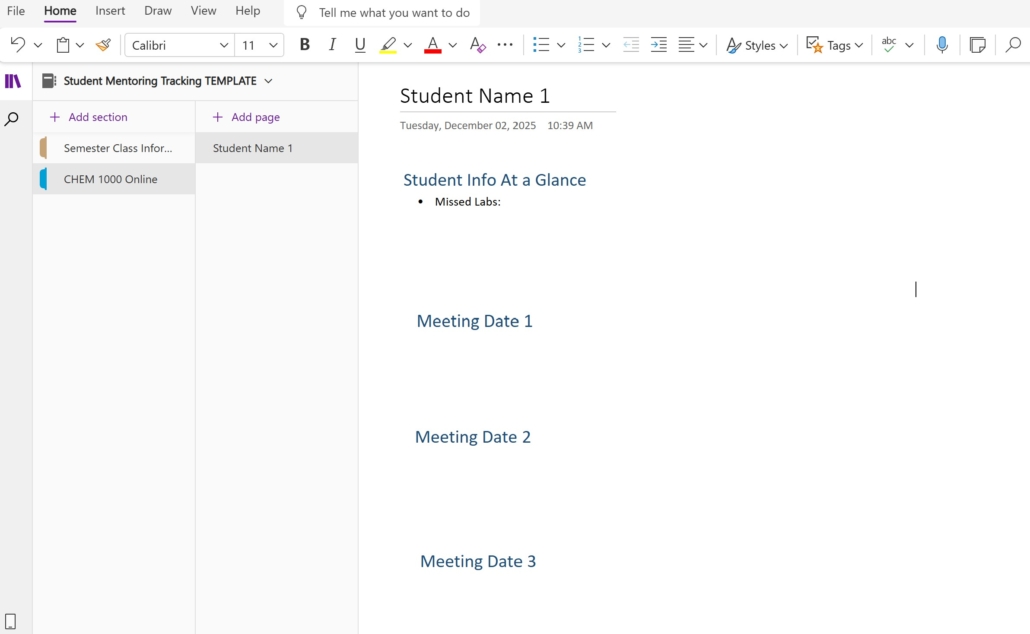
My OneNote student tracking layout.
Supporting Students in Developing Information Literacy Webinar by OneHE
I have included a lesson on information literacy in all of my classes since the pandemic. I noticed the influx of misinformation and disinformation online. I also observed the difficulty people have in distinguishing a good source from a bad one. I created a lesson to teach students how to access scientific literature, read it, and evaluate the reliability of a source.
Sara Miller, the Librarian for Interdisciplinary Teaching and Learning Initiatives at Michigan State University, and Craig Gibson, professor and Professional Development Coordinator in the Libraries at the Ohio State University, facilitated this webinar on December 3, 2025. I hoped this webinar would provide me with additional perspectives and information to include in my lesson. While it didn’t provide me with any new information to add to my lesson on information literacy, it did offer some perspectives to use when addressing this content. For example, have students state their chosen career field and then identify a relevant source for this field and explain why it’s a trusted source. I also realized I define what a scholarly source is in the material I provide students, but I never ask them to explain why they might use one or who creates these sources. These are all pieces I will add to my information literacy lessons when I revise this content later in the spring.
The Grocery Store as Chemistry Educator Webinar by the American Chemical Society
Scott Donnelly, faculty at Arizona Western College, presented on creating labs that investigate the world through the use of actual phenomena and the relevance of chemistry to everyday things on December 5, 2025. He discussed how he built his class around exploring the three major reactions for the world: photosynthesis, combustion, and fermentation. Examples of this approach to teaching include investigating the ingredients in bug repellent, discussing the chemical difference between the grades of gasoline, creating a standard curve to determine the optical rotation of Fanta Soda, and evaluating the difference between nitrates and nitrites in food.
This presentation gave me some great ideas on how to incorporate more real-world chemistry into my classes. I plan to include a discussion on the difference in gasoline grades and nitrates and nitrites in food in my introduction to chemistry class. These are great examples of real-world chemistry that apply to Goal 10: People and the Environment.
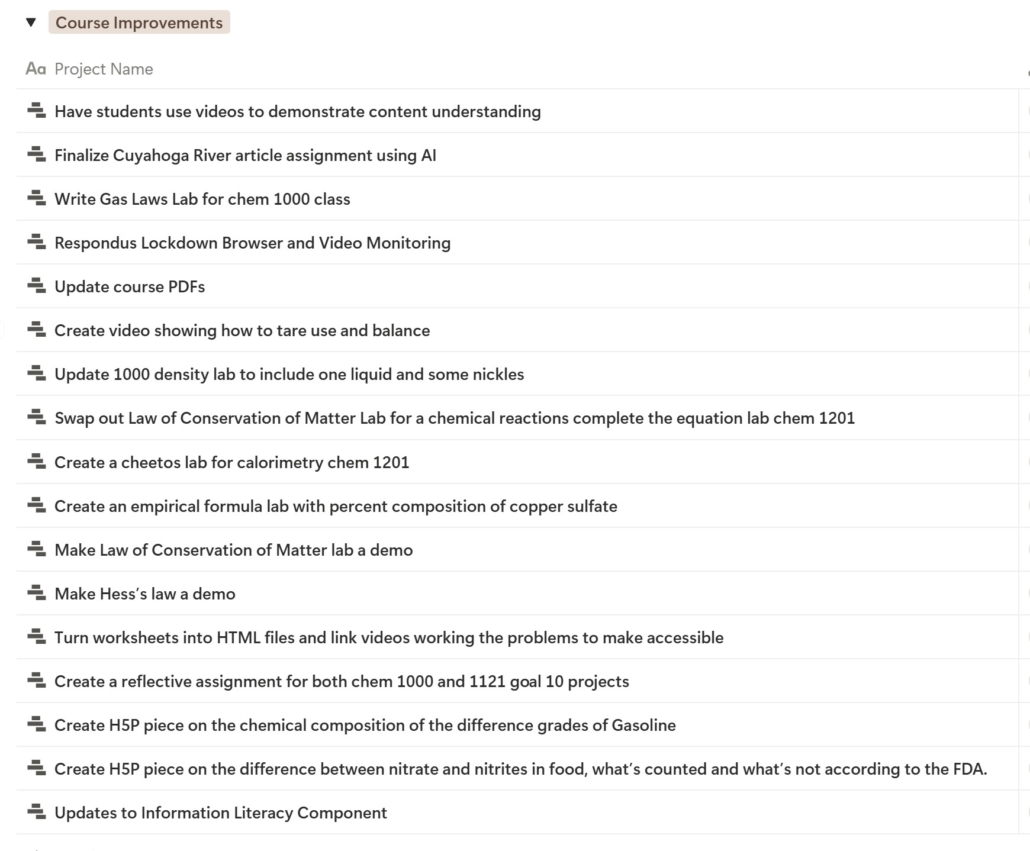
Partial list of ideas I have compiled while on sabbatical.
Some Unmentioned Benefits and Potential Hazards of a Sabbatical
I have written extensively about what I am learning during my sabbatical, but I also want to address how that learning is turning into ideas. I have shared some of these ideas in my blog posts; however, I have kept a list of the ideas for course improvements and other content since my sabbatical started. A screenshot of this list is provided at right. These ideas could fill another sabbatical (or two). Some of these ideas will come to fruition, others will die in an idea parking lot due to a lack of time. I can’t make every idea I come up with a reality. I don’t have the time, resources, or energy. No one does; however, a lot of these ideas will eventually end up in one or more of my classes. This will refresh my curriculum, provide more relevant content for students, and hopefully improve students’ chemical understanding and its application to daily life.
Learning allows for new ideas. The space a sabbatical provides allows for those ideas to develop.
References
Gabriel, K. F. (2008). Teaching Unprepared Students: Strategies For Promoting Success and Retention In Higher Education. Routledge.
Krogerus, M., & Tschäppeler, R. (2024). The Collaboration Book: A Guide To Achieving Great Things Together. W. W. Norton & Company.
Røyne, A. (2020). The Elements We Live By: How Iron Helps Us Breathe, Potassium Lets Us See, and Other Surprising Superpowers Of the Periodic Table. The Experiment.
Tessmer, M. (2005). PCBs in the Final Frontier: A Case Study on the Scientific Method. Journal of College Science Teaching, October 2025, 34-36. https://www.nsta.org/resources/pcbs-last-frontier-case-study-scientific-method