Books Read
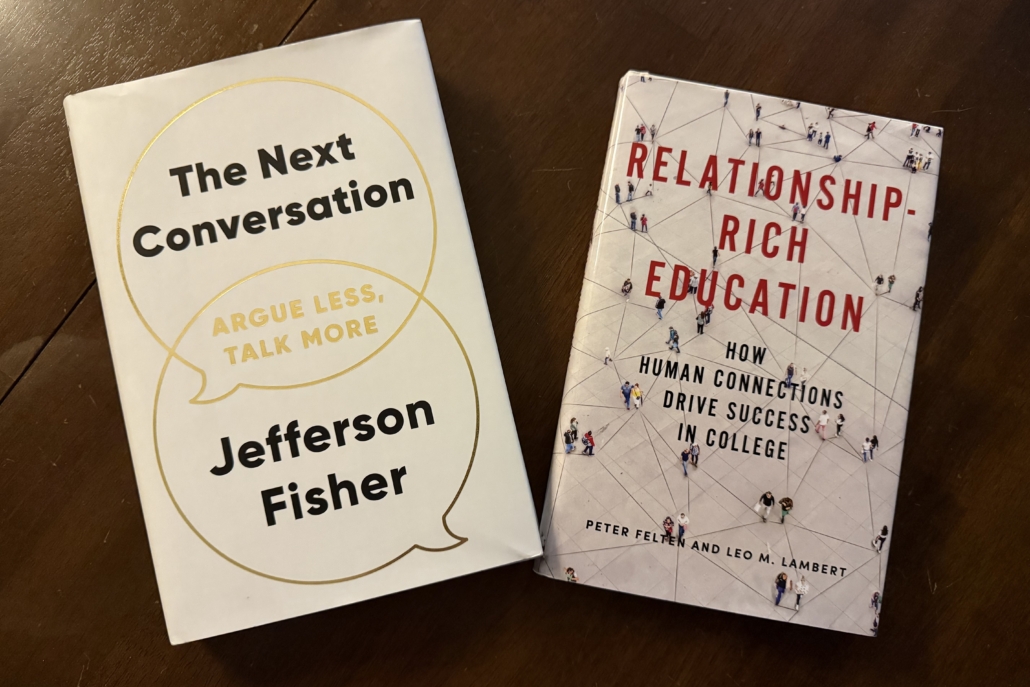
The Next Conversation
This month’s Leadership Read was The Next Conversation by Jefferson Fisher. This book is a how-to manual for improving your communication skills. Each chapter is designed to be a lesson to improve your conversational skills. Fisher encourages the reader to work on the lessons in the book one at a time. The author’s goal is to help people make connections during their conversations with others. He writes that each conversation should follow 3 rules (pg 15):
- Say it with control.
- Say it with confidence.
- Say it to connect.
In a world where groups of people are being dehumanized, Fisher emphasized that we must humanize others. He reminds us that the person we see isn’t the person we are talking to (pg 30) because everyone we meet every day has hidden concerns, problems, and situations in their life we know nothing about. He talks about adjusting your goals in a conversation (i.e., try to learn something rather than prove your point), staying grounded in your body and being aware of bodily cues to maintain self-control, how to deal with rude people, and how to set and hold boundaries with others. Everything he discusses ties back to meeting the three rules mentioned on page 15.
The lesson that I want to work on first is from chapter 8 on dealing with difficult people. It is so easy to get triggered by difficult people and end up feeling emotionally drained and frustrated when they get your goat. Fisher gives easy-to-follow instructions on how to stay in control of yourself, maintain boundaries, and respond to someone who is doing their best to get you worked up. One of the most useful tools he offers is sample conversations on how to deal with people who constantly interrupt, give fake apologies, or can’t respect your differing opinion. Every page of this book is dripping with powerful tools and perspectives on interacting with others respectfully and staying within your values when faced with a difficult person.
Relationship-Rich Education
I previously read The Coaching Habit: Say Less, Ask More, and Change the Way You Lead Forever by Michael Bungay Stanier a year or two ago as a Leadership Read. Since reading this book, I have been looking for better ways to connect with students and incorporate mentoring strategies in my work. This desire led me to include Relationship-Rich Education: How Human Connections Drive Success in College by Peter Felten and Leo M. Lambert in my sabbatical plan. This book is a phenomenal read, and I encourage anyone in education (faculty, staff, administration, etc.) to read it. The authors interviewed students, faculty, staff, and administration from twenty-nine higher education institutions (both 2- and 4-year) to write this book. I could spend the rest of my educational career (which I hope is very long) learning from and applying the programs, stories, and data I read in this book.
The authors identified four interlocking relationship principles that guide the cultures at colleges and universities that create relationship-rich cultures (pg 17):
- Every student must experience genuine welcome and deep care.
- Every student must be inspired to learn.
- Every student must develop a web of significant relationships.
- Every student must explore questions of meaning and purpose.
The book goes on to highlight instances of these principles at higher education institutions across the US. This book inspired me to reflect on my college experience, how I benefited from the relationships I built, and how I can encourage that development between my students and me. I also want to encourage more student-to-student relationships in my classes. As a result, I began to explore OneNote (I have access through Riverland) and how I can create a note-taking system to support this goal. My vision includes creating a “chart,” much like a medical professional does for their patients, where I can keep notes on meetings, struggles (both personal and academic) that my students have, and other important information that will help me build better relationships with my students. I am also going to include questions about a student’s why in introduction assignments in my classes and create end-of-semester reflective assignments to help students explore questions of purpose and meaning.
Webinars
Teaching Students to Collect and Interpret Data
I attended an American Chemical Society (ACS) webinar on using a thermal imaging device to help students learn to collect data, make predictions, and draw conclusions. This activity is intended for use in a general chemistry course, with the concept later revisited in organic chemistry. This activity also helped build student vocabulary by requiring them to use scientific terms in collecting data and describing the phenomenon observed during the activity.
While I am not interested in using this specific activity in my classes, it did give me some great ideas for the first chapter of the textbooks I am creating. I also obtained a different approach to data collection and drawing conclusions. I will incorporate this into the case study I complete with my classes during the second week of class. I think it will be an excellent opportunity to introduce these ideas before the class begins experiments the next week.
From Textbook to Tank Far: Teaching Chemistry with Real-World Applications
This is another ACS webinar hosted by their 2-year college division. Nicole Stephens, Ph.D., an analytical chemist with Homeland Energy Solutions LLC, discussed her path from higher education to working to find sustainable energy solutions and apply what she learned in the lab to real-world situations. She outlined the skills students build in the lab and demonstrated how they align with the work she does at an ethanol plant in northwest Iowa.
I am always looking for ways to include real-world connections in my courses. It helps make the concepts we are covering relevant to the students’ current situation and demonstrates how they apply in their future careers. I plan to build what I learned from this webinar into my labs to create connections between what some students see as unimportant (collecting and organizing data, being organized, following directions, etc) and how it will prepare them for their future careers. College is a time to learn and practice for later, and I want students to understand this applies to all of their classes, even the ones they think are unimportant.
As much as I don’t like to admit it, I understand some students think my class falls under “unimportant.” While it’s disappointing, I understand not everyone is a science nerd like me.
Asynchronous Online Teaching and Course Design in the Era of AI webinar
A friend and colleague introduced me to OneHe, an organization that provides teaching and professional development resources to higher education faculty. I attended their webinar on Asynchronous Online Teaching and Course Design in the Era of AI on November 13. My primary takeaway from this webinar is that AI is a frictionless tool. Learning doesn’t occur when students use AI unless they 1) choose to learn or 2) educators build some friction into assignments. One way to do this is to create assignments that use the KWLR strategy. This requires students to state what they know before the assignment, list questions they want to learn during the lesson, state what they learned after the lesson, and support that learning from the reading they completed during the lesson. Questions an educator might ask using this format include:
- What did you already know about this topic before this week?
- What do you want to learn about the topic?
- What did you learn about this topic this week?
- What from the readings stood out to you and why?
Since I build several assignments into my classes that address Goal 10: People and the Environment, this is a great way to have students reflect on what they learned and make it harder for them to use AI to think for them.
National Science Teaching Association (NSTA) conference
I attended the NSTA conference in Minneapolis on November 15. I spoke with faculty from Gustavus Adolphus College about the importance of the Nobel Conference. I shared my gratitude for the October conference on sugar and expressed my anticipation for the 2026 conference on water. I teach water quality topics in my General Chemistry 1 and 2 classes, so the 2026 conference is directly applicable to my teaching. I also learned about how to use Canva to deliver course content, talked with other faculty about best practices and issues they experience in the classroom, and loved on some puppies in the exposition hall. All of the puppies were available for adoption.
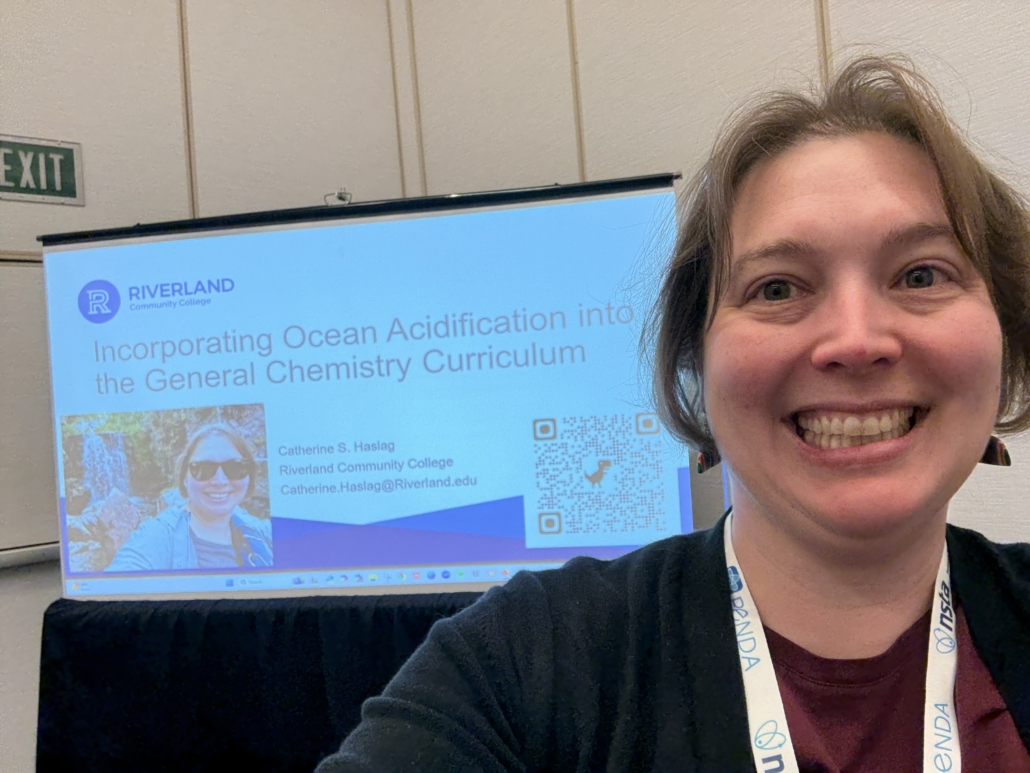
I also presented on how I incorporate ocean acidification as a research topic in my General Chemistry 2 course. I was scheduled to present during the second-to-last session of the conference. Five very engaged people attended. I am pleased with the engagement, considering I presented during lunch on a Saturday.
Service Items
Service was a significant piece of my sabbatical work this month.
- I reviewed scholarships for the Riverland Foundation. I participate as a reviewer during the fall and summer scholarship cycles. Scholarships supported me during my educational journey. I think it’s essential that I give back so others can reach their educational goals.
- I reviewed portfolios for the 2026 Minnesota State Board of Trustees Awards. Faculty throughout the system are nominated at the college/university level, and then some are elevated to the system level for acknowledgement. Nominees work with their institution to prepare a portfolio that includes their CV and Statement of Teaching Philosophy; a summary statement that outlines the nominee’s teaching strategies, service to the college, professional development, and other actions that make the nominee an outstanding educator; and a letter of support from their institution’s president. I was honored as an Outstanding Educator by the Board of Trustees in 2020, 2022, and 2025. I enjoyed being on the other side of this effort as a portfolio reviewer. Reviewers assess each portfolio and provide feedback that is used to select the Educator of the Year. This year, we selected two Educators of the Year from more than 25 applicant portfolios. It was a much harder job than I anticipated because there were so many incredible educators. I enjoyed reviewing the portfolios and seeing what other educators are doing in their classrooms and beyond. I learned a great deal and obtained many ideas on encouraging ethical use of AI, assisting students with building foundational study and note-taking skills, and creating authentic learning experiences for my students.
- One of my colleagues and I are working to establish a student affiliate of the American Association of University Women (AAUW) at Riverland. The goal is to connect members of our community with students and provide educational events for students. This project is in its early stages. We hope to launch this in Fall 2026.
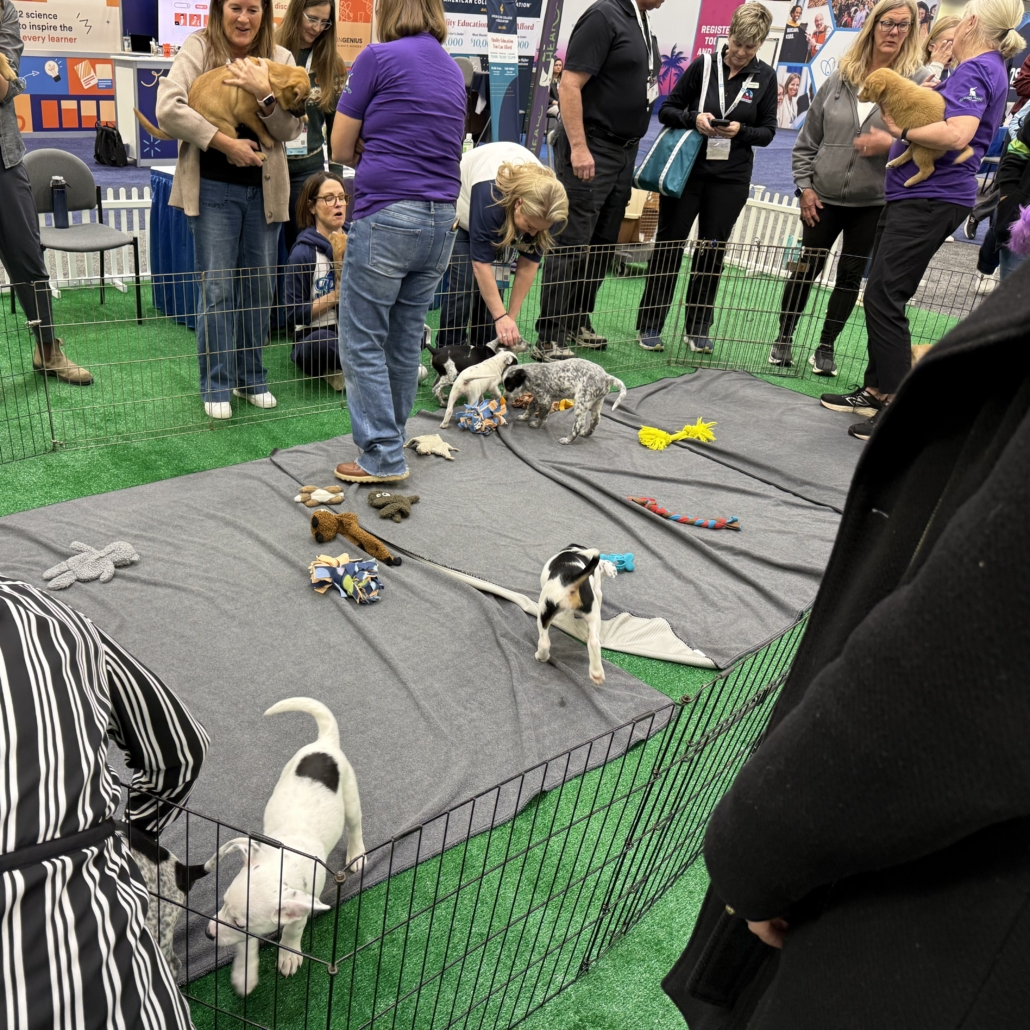
Above – Puppies available for pets and adoption at the NSTA conference.
Below – Preparing to present at the conference.
References
Felten, P., & Lambert, L. M. (2020). Relationship-Rich Education : How Human Connections Drive Success In College. Johns Hopkins University Press.
Fisher, J. (2025). The Next Conversation : Argue Less, Talk More. Tarcher Perigee, an imprint of Penguin Random House LLC.
Minnesota State. (2025). Recipients of the Board of Trustees Awards for Excellence. https://www.minnstate.edu/stories/botawards/recipients.html
Tessmer, M. (2005). PCBs in the Last Frontier: A Case Study on the Scientific Method. National Science Teaching Association. https://www.nsta.org/ncss-case-study/pcbs-last-frontier (NSTA)
U.S. Environmental Protection Agency. (2024). Radon Zones Map. https://www.epa.gov/system/files/documents/2024-05/radon-zones-map_text_link.pdf